
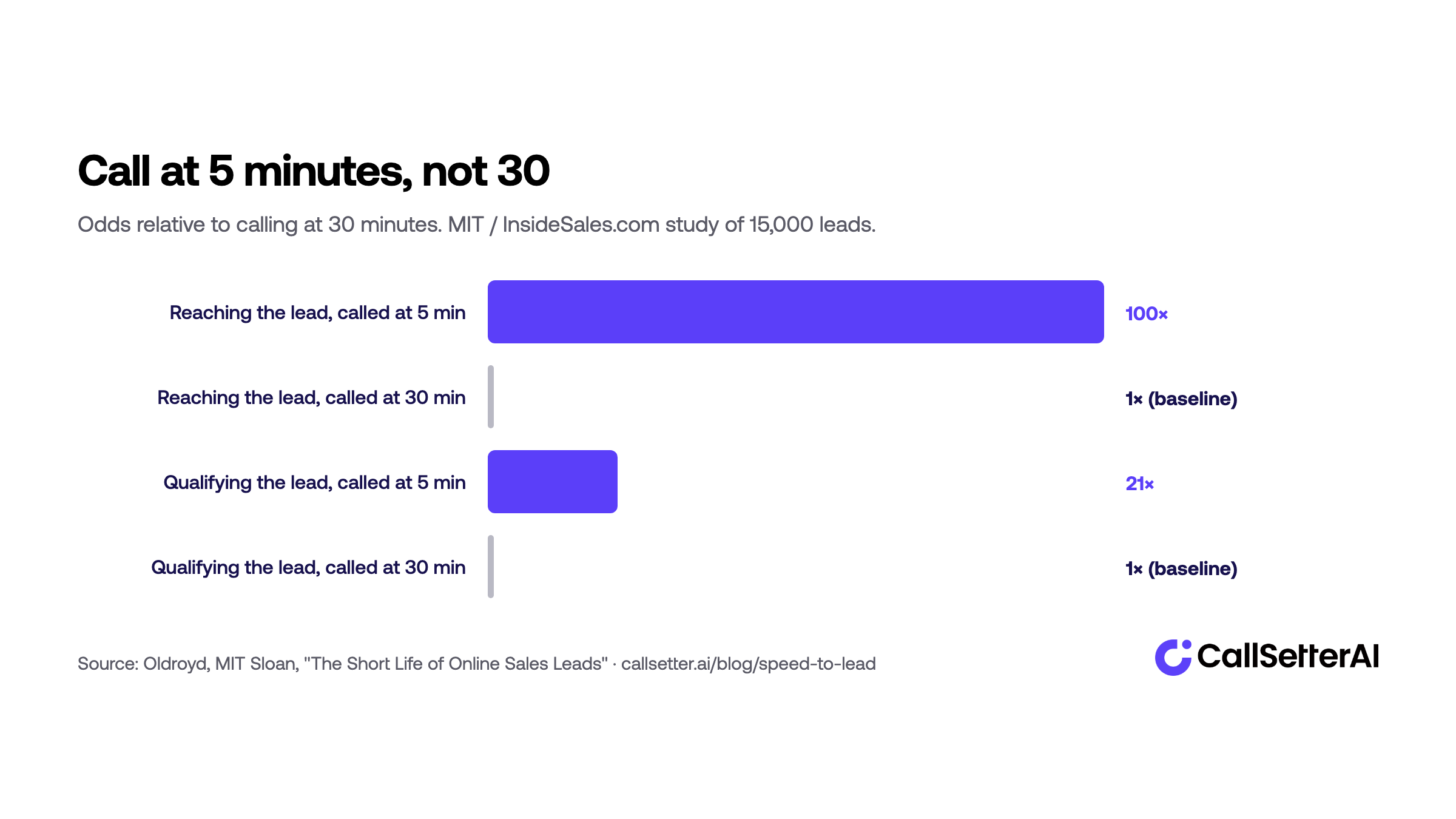
Respond to a new lead inside 5 minutes and you are 21 times more likely to qualify it than a company that waits 30, according to research run at MIT across more than 15,000 leads. The average business takes 42 hours. That distance between what the data says to do and what almost everyone actually does is the cheapest competitive advantage available to a service business, and it does not require a better product, a bigger ad budget, or a smarter pitch.
Embed this chart (free, attribution required)
What this guide covers
- What speed to lead actually measures
- The MIT study that started it
- The 3,500,000 lead study that confirmed it
- The 42-hour gap between advice and practice
- How a lead loses value, hour by hour
- Speed to lead vs speed to conversation
- Why most businesses stay slow
- How to measure your own number
- What slow response costs you
- The 60-second playbook
- The three fixes, with real costs
- What a saved lead is worth by industry
- Frequently asked questions
- Methodology and sources

What Speed to Lead Actually Measures
Speed to lead is one subtraction: the moment a lead arrives, subtracted from the moment you first try to contact them. A form submitted at 9:02 and a call placed at 9:04 is a speed to lead of two minutes. Nothing about the quality of the call is in that number, which is both why it is easy to track and why it is easy to game.
Four timestamps describe the whole journey, and most businesses only ever look at the first two:
- Lead created. The form hit your CRM, the call rang, the chat opened.
- First attempt. Someone dialled, texted, or emailed. This is where speed to lead stops counting.
- First conversation. A human on the other end actually said hello. This is the number that predicts qualification.
- Appointment booked. The outcome you are actually paying for.
A team can look excellent on step two and lose every deal at step three. That failure mode has its own section below, because it is the most common way a business with a respectable dashboard still loses to a competitor who answers the phone.
The MIT Study That Started It
The foundational research is "The Short Life of Online Sales Leads" by Dr. James Oldroyd, then at MIT Sloan, run with InsideSales.com and later written up in Harvard Business Review. The method was plain: take more than 15,000 web-generated leads across more than 100 companies, record when each lead arrived, record when the company responded, and compare outcomes across response intervals.
Two findings came out of it, and both are ratios rather than percentages, which is why they have survived fifteen years of retelling. Calling a lead at 5 minutes rather than 30 made a company 100 times more likely to make contact. It also made them 21 times more likely to qualify that lead into the pipeline.
The odds of contacting a lead if called in 5 minutes versus 30 minutes drop 100 fold. The odds of qualifying a lead if called in 5 minutes versus 30 minutes drop 21 fold.
Dr. James Oldroyd, MIT Sloan School of Management, "The Short Life of Online Sales Leads"The word doing the work there is odds. This is not a claim that 100 times more leads close. It is a claim that the probability of a connection collapses across a 25 minute gap, and that everything downstream inherits that collapse. The same research programme produced the finding that the best window to place the call is between 4pm and 6pm in the lead's own time zone, and that persistence matters as much as speed: most companies stop after one or two attempts, well short of the point where contact rates peak.
The 3,500,000 Lead Study That Confirmed It
MIT's sample was large enough to be credible and small enough to argue with. Velocify, later part of ICE Mortgage Technology, settled the argument with a study of 3,500,000 sales leads across multiple industries.
Their headline number is the one that gets quoted everywhere: leads called within one minute of inquiry converted at a rate 391% higher than leads called at the two minute mark. Not an hour later. One minute later. The curve is at its steepest in the seconds immediately after the lead arrives, which is precisely the window no human team can cover reliably, because it requires someone free, alert, and holding a phone at the exact second a stranger fills in a form.
Velocify's data also supports the persistence side of the equation: contact rates keep climbing across roughly six attempts before they flatten. Speed gets you the first conversation. Persistence gets you the ones who were in a meeting.

The 42-Hour Gap Between Advice and Practice
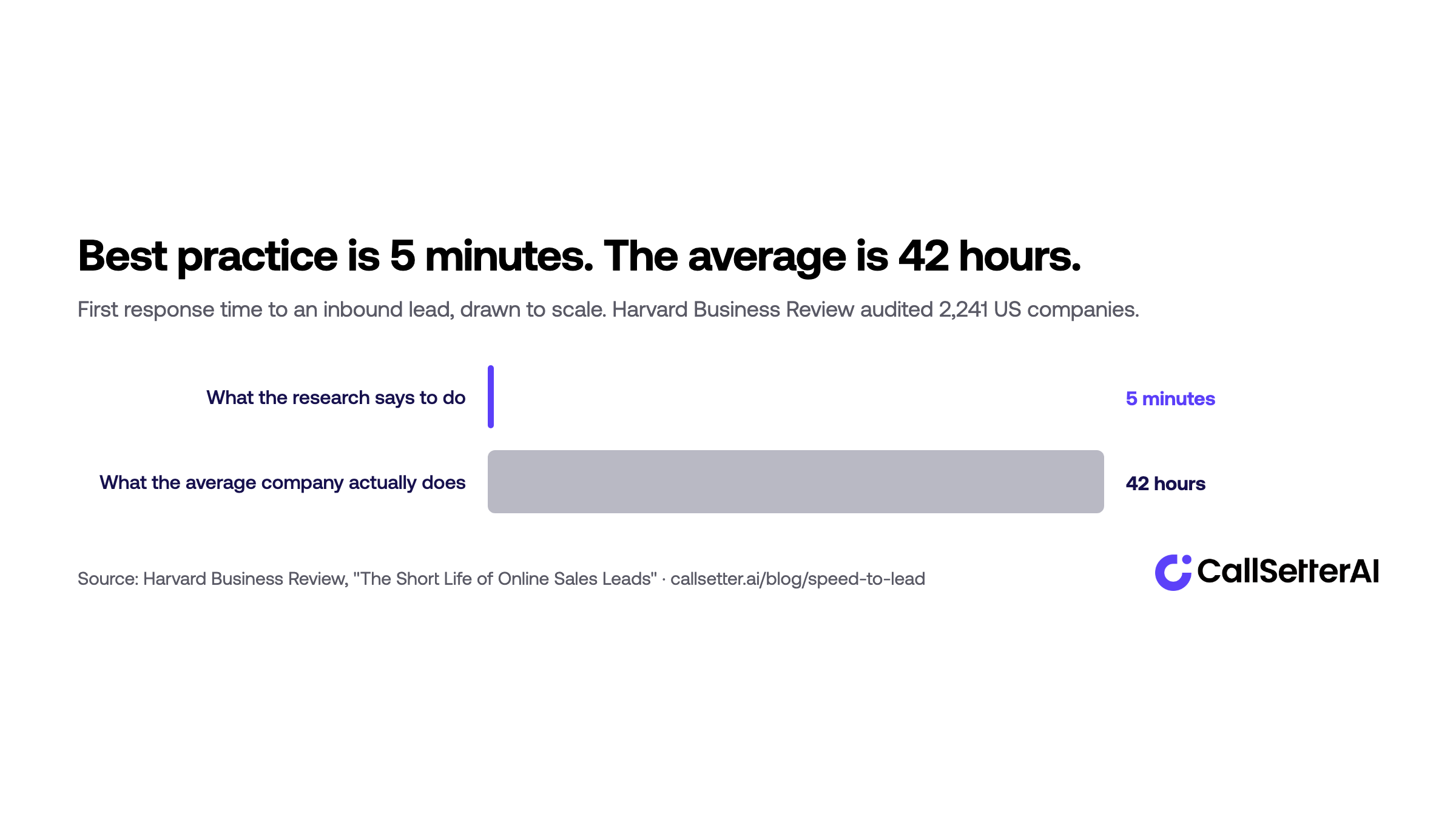
Every business owner reading the numbers above agrees with them. Almost none of them act on it. Harvard Business Review audited the lead response behaviour of 2,241 US companies and found an average first response time of 42 hours. Nearly a quarter of the companies audited, 23%, never responded at all.
Embed this chart (free, attribution required)
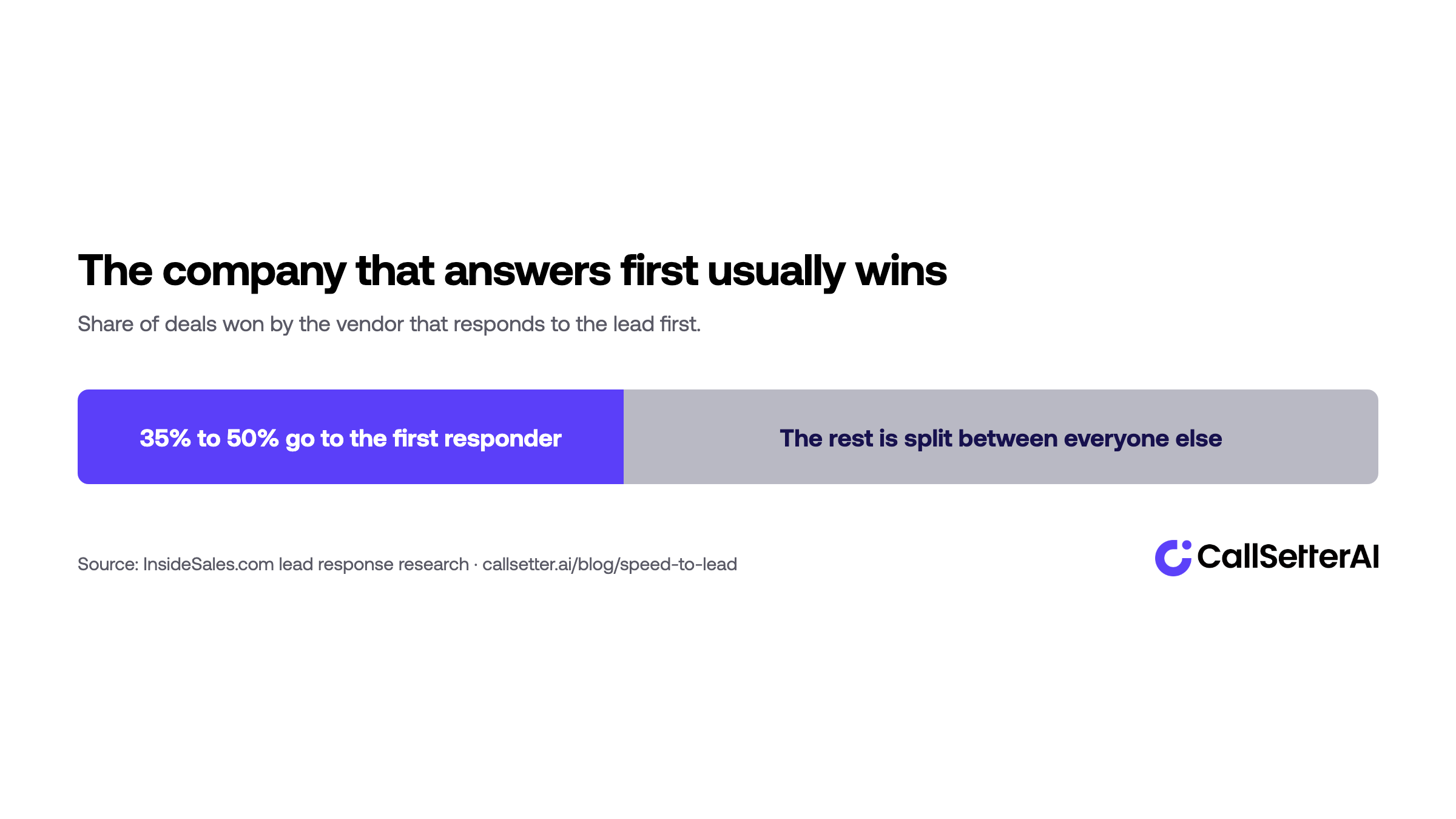
Read that chart as a market map rather than a scolding. In most local service categories, every competitor you have is somewhere on the grey bar. Being anywhere near the violet one is not an optimisation, it is a different category of business. InsideSales.com research puts the value of that position at between 35% and 50% of deals going to whoever makes contact first, largely independent of price, brand, or pitch quality.
Embed this chart (free, attribution required)

How a Lead Loses Value, Hour by Hour
Lead decay is not a straight line down. It is steepest at the start, which is the opposite of how most follow-up processes are built. The numbers below are the research findings above, laid against the clock. Our 2026 speed to lead statistics report carries the underlying figures in more detail.
Answer Every Lead Inside 60 Seconds
CallSetter AI calls the moment a lead lands, qualifies them on the phone, and books straight into your calendar. Nights, weekends, and the ten minutes your front desk is on another line.
Book a Demo
Speed to Lead vs Speed to Conversation
Speed to lead measures how fast you try. Speed to conversation measures how fast you succeed. They are different numbers and the gap between them is where deals quietly die.
A rep who dials at three minutes and reaches voicemail has an excellent speed to lead and no conversation at all. The lead is still unclaimed, and the clock is still running. This is how a team with a healthy dial report loses to a competitor with a worse one: their speed to lead is minutes and their speed to conversation is hours. Every number MIT measured counts contact, not attempts, which makes speed to conversation the metric that actually predicts qualification.
Two things close the gap. Call at the hours people answer, which the same MIT research programme put between 4pm and 6pm in the lead's own time zone. Or remove the dependency on a human being free at the right second by using an AI appointment setter that dials within seconds and holds the conversation the moment the lead picks up. For the industry by industry response data, see our lead response time benchmarks.
Why Most Businesses Stay Slow
The reason is structural, not motivational. Nobody decides to answer leads slowly. They build an operation that cannot answer them quickly, and then the leads arrive anyway.
Leads do not respect office hours
Research from Ruby Receptionists puts 35% to 45% of calls to service businesses outside standard 9 to 5 hours. A homeowner searches for AC repair at 10pm because the air conditioning died at 10pm. A business owner fills in a demo form at 7am before the day starts. Our guide to after hours call answering with AI covers how those hours get covered without a night shift.
Capacity is fixed and demand is not
Even inside business hours, you have a finite number of people who can pick up. Volume is not evenly distributed: ServiceTitan data shows home service companies take around 40% of their weekly call volume on Monday and Tuesday mornings. When three calls land while your receptionist is on a fourth, the overflow goes to voicemail, and Numa found 85% of those callers never try again.
The person in front of you always wins
Front desk staff are juggling existing customers, scheduling changes, and walk-ins. New lead response competes with all of it and consistently loses, because a customer standing at the counter feels more urgent than a form submission nobody has read. That is a rational human priority and it is exactly what costs you the lead.
Marketing spend makes the problem worse, not better
Turning up ad spend raises call volume against the same fixed capacity. Google reports businesses running Local Services Ads see 2 to 5 times their normal call volume. If the extra calls land in voicemail, you have paid a cost per lead of $45 to $75, per WordStream home services benchmarks, to generate conversations that never happened. Our cost of missed calls analysis puts a number on that.
How to Measure Your Own Number
Most businesses quoting a speed to lead figure are quoting the wrong statistic from the wrong sample. Four rules make the number real.
- Stamp all four moments. Lead created, first attempt, first conversation, appointment booked. Three of those usually already exist in your CRM. The one people skip is first conversation, and it is the one that predicts revenue.
- Report the median, never the mean. One lead answered nine days late drags an average into fiction. The median tells you what a typical lead actually experienced.
- Split by hour and by weekday. A respectable overall number almost always hides a nights and weekends problem. Look at Saturday on its own before you believe the headline.
- Count the leads you never contacted at all. They are silently excluded from every response time average, and they are the worst outcome in the data set. Harvard Business Review found 23% of companies live entirely in this bucket.
The one number to put on the wall: the share of leads that had a two-way conversation inside 5 minutes. It is hard to fake, it maps directly onto the MIT finding, and it moves the moment you fix anything real.
What Slow Response Costs You
The research gives ratios, not dollars. Turning ratios into dollars requires assumptions about your business, so this calculator asks you for them rather than burying them. Every input is yours, and the arithmetic is printed underneath.
Speed to lead revenue calculator
Runs entirely in your browser. No form, no email gate, no hidden multipliers.
The formula, in the open: (leads per month x fast reach rate) minus (leads per month x current reach rate) = extra leads reached. Multiply that by your close rate and your revenue per job for the monthly figure, then subtract what you pay to answer. The two reach rates are yours to set. We do not supply a decay curve here, because the right one for your industry is not ours to guess. The MIT and Velocify findings above tell you which direction the second number moves, not what it equals.

The 60-Second Playbook
Speed to lead is not one decision. It is six, and every one of them has a default that is slower than it needs to be.
Fire on the event, not on a schedule
A CRM that polls for new leads every 15 minutes has already spent three times the MIT window before anyone dials. Trigger on the webhook, not the sync.
Call first, text second, email last
The phone is the only channel that produces a conversation inside the window. Text is the fallback when the call is not answered, not the opener.
Qualify and book in the same call
Every handoff to a callback restarts the clock and reintroduces every problem the speed was supposed to solve. Check the calendar while they are still on the line.
Plan for six attempts, not one
Velocify's data shows contact rates climbing across roughly six attempts. Most teams stop after one or two, then describe the lead as bad.
Cover the hours that generate the leads
With 35% to 45% of calls landing outside office hours, an operation that only answers 9 to 5 is choosing to lose a third of its pipeline on schedule.
Review the median, split by day
Put the share of leads that had a conversation inside 5 minutes on a weekly report. What gets reported weekly is the only thing that stays fixed.
The Three Fixes, With Real Costs
There are three ways to get consistent sub-5-minute response. They differ enormously in cost, and only one of them holds at 2am on a Sunday.
Hire more people
Covering all hours and peak volumes with staff means several people, not one. The Bureau of Labor Statistics put the median receptionist wage at $36,920 as of May 2023, before benefits, management overhead, or turnover. Round-the-clock coverage runs into six figures annually, and it solves the after-hours gap without solving the peak-hour overflow. Our AI receptionist vs human comparison works the numbers through.
Use an answering service
Answering services take a message and promise a callback. Ruby publishes $250 a month for 50 receptionist minutes, rising to $1,725 for 500. Smith.ai publishes $300 for 30 calls, which is about $10 a call. Both shorten the speed to lead gap. Neither closes the speed to conversation gap, because the lead is still waiting for someone to ring them back.
Put an AI voice agent on it
An AI appointment setter dials inside seconds of the lead arriving, at any hour, without needing anyone to be free. It qualifies on the call, checks live calendar availability, and books in the same conversation, which is the only one of the three options that closes both gaps at once. CallSetter AI starts at $497 a month plus a one-time build. The full market, including the cheaper build-it-yourself platforms, is priced out in our AI appointment setting cost guide.
Speed to lead is the rare metric where the research is settled, the benchmark is public, and almost nobody hits it. That combination does not survive in most markets. It survives in this one because fixing it used to require hiring a night shift.
What a Saved Lead Is Worth by Industry
Response speed is worth whatever a job is worth. The figures below come from each industry's own bodies and are the same sources used in our cost of missed calls analysis.
| Industry | Value of one captured lead | Why speed matters here | Source |
|---|---|---|---|
| HVAC | $300 to $500, emergencies $1,500 to $5,000+ | Emergency calls go to whoever picks up, at any hour | ACHR News |
| Dental | $653 first year, $10,000 to $25,000 lifetime | New patients call several practices in one sitting | ADA / Levin Group |
| Legal | $3,000 to $50,000+ per matter | Intake calls are urgent and the first firm to answer usually signs | Clio |
| Solar | $15,000 to $30,000 per installation | Homeowners collect three to five quotes at once | Solar appointment setting guide |
| Real estate | $10,000 to $12,000 buyer agent commission | Zillow measured a 100x connection advantage at 5 minutes | NAR / Zillow |
Where to Go Next, Based on Your Situation
- You want to hear it working on your own line: book a CallSetter AI demo. We time your current response, then show the AI answering and booking live.
- You want the price before the pitch: CallSetter AI pricing, or the whole market in the AI appointment setting cost guide.
- Most of your leads arrive at night: read AI phone answering for after-hours calls.
- Your problem is missed calls rather than slow callbacks: the cost of missed calls puts a number on it, and missed call text back covers the stopgap.
- You want your industry's setup: HVAC, plumbing, roofing, solar, dental, or law firms.
Frequently Asked Questions
What is speed to lead?
Speed to lead is the time between a potential customer submitting a form, calling, or requesting information and your business making first contact. MIT and InsideSales.com research puts the useful window under 5 minutes. Past that, both the odds of reaching the lead and the odds of qualifying them fall sharply.
How fast should you respond to a new lead?
Under 60 seconds is the target. Velocify's study of 3,500,000 leads found that calling within one minute produced a 391% higher conversion rate. At 5 minutes you are still 21 times more likely to qualify the lead than at 30 minutes, according to the MIT research.
What is the average speed to lead?
42 hours. Harvard Business Review audited the lead response of 2,241 US companies and found an average first response time of 42 hours, with 23% of companies never responding at all. That gap between best practice and normal practice is the whole opportunity.
What is the difference between speed to lead and speed to conversation?
Speed to lead measures how fast you make the first contact attempt. Speed to conversation measures how fast you get a real two-way exchange. A rep who dials in 3 minutes but reaches voicemail has a great speed to lead and no conversation at all. The MIT research counts contact, not attempts, which is why speed to conversation is the number that predicts qualification.
How do I measure speed to lead in my own CRM?
Record four timestamps on every lead: when it arrived, when the first outbound attempt fired, when a two-way conversation started, and when an appointment was booked. Report the median rather than the average, because one lead answered a week late will drag an average badly. Split the report by hour of day and by day of week, since almost every business has a nights and weekends problem hiding inside a healthy-looking overall number.
Can AI improve speed to lead?
Yes. An AI voice agent places the call within seconds of the lead arriving, at any hour, without waiting for a human to be free. It qualifies the caller, checks live calendar availability, and books the appointment inside the same conversation, which closes the speed to conversation gap rather than only the speed to lead gap.
What percentage of deals go to the company that responds first?
Between 35% and 50%, according to InsideSales.com lead response research. The first company to make contact wins the deal roughly that often regardless of other competitive factors, which is why response time behaves less like an operational metric and more like a market share lever.
Methodology and Sources
Every statistic on this page traces to a named source below. Where the original report is no longer online we link the publisher's research hub. Anything marked as a CallSetter AI example is arithmetic on stated inputs, not third-party research. All source links were checked live on August 11, 2026.
- 100x contact odds and 21x qualification odds, 5 minutes vs 30: Oldroyd, MIT Sloan / InsideSales.com, "The Short Life of Online Sales Leads", 15,000+ leads across 100+ companies. Written up in Harvard Business Review.
- 391% higher conversion when called inside one minute: Velocify lead response study, 3,500,000 leads.
- Contact rates climbing across roughly six attempts: Velocify lead management research.
- 42-hour average first response, 23% never responding, 7x qualification advantage inside the hour: Harvard Business Review audit of 2,241 US companies. hbr.org
- 35% to 50% of deals going to the first responder, and the 4pm to 6pm calling window: InsideSales.com lead response research.
- 35% to 45% of calls arriving outside business hours, and published receptionist plan pricing: Ruby Receptionists. ruby.com/pricing, read August 11, 2026.
- Smith.ai published pricing of $300 for 30 calls: smith.ai/pricing, read August 11, 2026.
- 22% of calls missed and 85% of callers never calling back: Numa, 2021 Small Business Phone Report. numa.com
- 40% of weekly call volume on Monday and Tuesday mornings: ServiceTitan industry data. servicetitan.com
- 2x to 5x call volume from Local Services Ads: Google Ads benchmarking. ads.google.com
- $45 to $75 cost per lead in home services: WordStream Google Ads benchmarks. wordstream.com
- $36,920 median receptionist wage, May 2023: US Bureau of Labor Statistics. bls.gov
- Industry job values: ACHR News (HVAC), ADA and Levin Group (dental), Clio (legal), NAR and Zillow (real estate).
- The calculator above multiplies your own inputs and shows its formula on screen. It contains no decay curve, no industry assumption, and no CallSetter figure other than the monthly cost you type in.
How to Cite This Page
You are welcome to reference the numbers and charts on this page. Copy the citation below and link back to the canonical URL.